

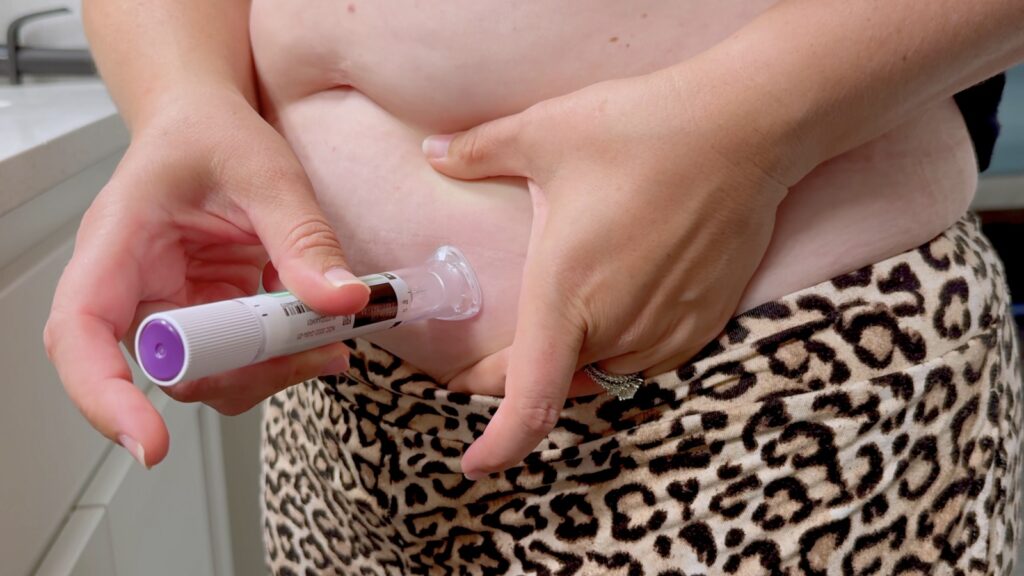
What is a GLP-1 Agonist?
GLP-1 (glucagon-like peptide-1) drugs like semaglutide (you may know the brand names Ozempic and Wegovy) are GLP-1 receptor agonists. Glucagon-like peptide-1 is an incretin hormone naturally released in the human body in response to food and secreted from the gut.
GLP-1 agonist medications work by mimicking this naturally occurring hormone.
When blood sugar rises (you eat a meal), these drugs stimulate the body to produce more insulin to support and lower blood sugar levels (homeostasis). These drugs also help your body and muscles utilize glucose.
At this point, you may have wondered about hypoglycemia or your blood sugar dropping. We get this question a lot, and it is a legitimate concern!
The pancreas should only increase insulin production when blood sugar is high, but this is still a concern and should be monitored closely; other medications used to treat type 2 diabetes can increase your risk of low blood sugar, and each patient should discuss all medications with their healthcare provider.
Contact us today to schedule a free orientation.
How Do GLP-1 Drugs Help with Weight Loss?
This is a great question! The research shows that these drugs have a lot of different mechanisms to help people lose weight; let’s take a look below…
- Central Nervous System Effects to Decrease Appetite: GLP-1 receptors are found in the central nervous system of the brain region associated with appetite and food intake
- Reduced Glucagon Release: This mechanism happens by increased glucose uptake in the muscles, then leading to decreased glucose production in the liver, neuroprotection, and increased satiety due to direct actions on the hypothalamus
- Increase in Insulin Release and Sensitivity: GLP-1 is an incretin hormone that stimulates insulin secretion after an increase in oral glucose load (eating) via the incretin effect
- Slower Gastric Emptying: GLP-1 slows down food movement through the stomach to help you feel fuller longer. This leads to increased satiety or prolonged fullness
When Should GLP-1s Like Semaglutide Be Used for Weight Loss?
Wegovy (semaglutide) is a GLP-1 medication that is highly effective in appetite suppression and weight loss.
The combined effects of increased insulin release, reduced glucagon secretion, delayed gastric emptying, appetite suppression, and decreased food preference aid in effective weight loss. Patients must get an adequate amount of micronutrients and macronutrients.
As we tell our patients in the clinic quite frequently, “All weight loss is not healthy weight loss,” because you want to preserve and lose as minimal lean muscle mass as possible.
Our team at CONCI recommends close dietary support, use of high-protein meal replacements, and repeating In-Body testing to monitor the loss of fat mass and lean muscle mass.
- It is essential to have close dietary recommendations to support healthy weight loss and mitigate side effects from GLP-1s
- It is important to incorporate sustainable lifestyle strategies to optimize the effectiveness of GLP-1s and weight loss. Our clinic has specific diet plans in place utilizing registered dieticians to help with food-based diets and meal replacement products (MRP)
Key Takeaways or Clinical Pearls (as we call them in medicine):
- Wegovy (semaglutide) is a GLP-1, which is a synthetic form of the naturally occurring incretin hormone in the body that is secreted by the gut (glucagon-like peptide 1)
- Wegovy (semaglutide) is a GLP-1 that aids in weight loss through appetite suppression, increased satiety, fewer food cravings, and slower gastric emptying
- All weight loss is not healthy weight loss; the goal is to preserve or lose as little muscle mass as possible
- It is essential to work towards sustainable lifestyle strategies to optimize the effects of weight loss medications. A comprehensive weight loss team of experienced providers and registered dieticians is critical!
Contact CONCI today for more information or to schedule a free orientation.
Sources
- Collins, L., & Costello, R. A. (2024). Glucagon-Like Peptide-1 Receptor Agonists. In StatPearls. StatPearls Publishing.
- Muzurović, E. M., Volčanšek, Š., Tomšić, K. Z., Janež, A., Mikhailidis, D. P., Rizzo, M., & Mantzoros, C. S. (2022). Glucagon-Like Peptide-1 Receptor Agonists and Dual Glucose-Dependent Insulinotropic Polypeptide/Glucagon-Like Peptide-1 Receptor Agonists in the Treatment of Obesity/Metabolic Syndrome, Prediabetes/Diabetes and Non-Alcoholic Fatty Liver Disease-Current Evidence. Journal of Cardiovascular Pharmacology and Therapeutics, 27, 10742484221146371. https://doi.org/10.1177/10742484221146371
- U.S. Food and Drug Administration. (2021). The FDA approved a new drug treatment for chronic weight management, the first since 2014. Food and Drug Administration. Retrieved from: https://www.fda.gov/news-events/press-announcements/fda-approves-new-drug-treatment-chronic-weight-management-first-2014
- Obesity Algorithm. (2022-2023). Obesity Medicine Association. Retrieved from https://obesitymedicine.org